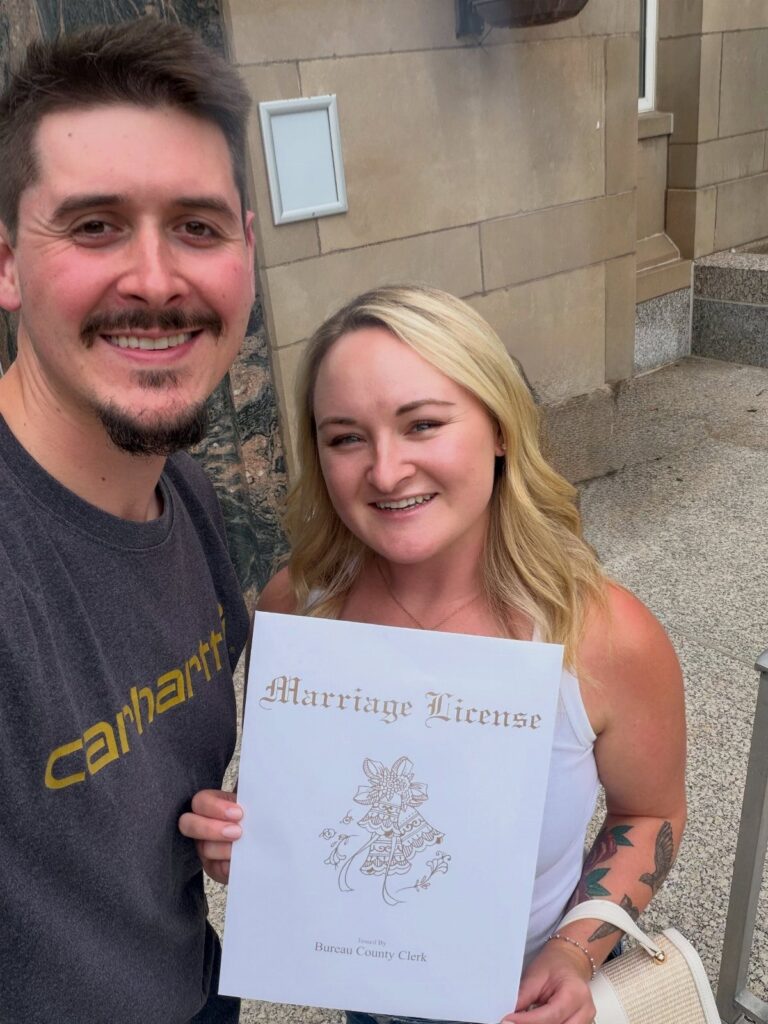
This checklist covers 7 items, from the cheap ones like a marriage license and wedding favors to the ones that scale with your budget, such as a planner’s fee, vendor tips, and an insurance policy.
Your date sets the order: the marriage license rules and the insurance quote come first, since both tie to the day you pick, while favors and the seating chart can wait until your RSVPs are in.
Start with whatever involves a deposit or a deadline you can’t move.
1. Marriage License
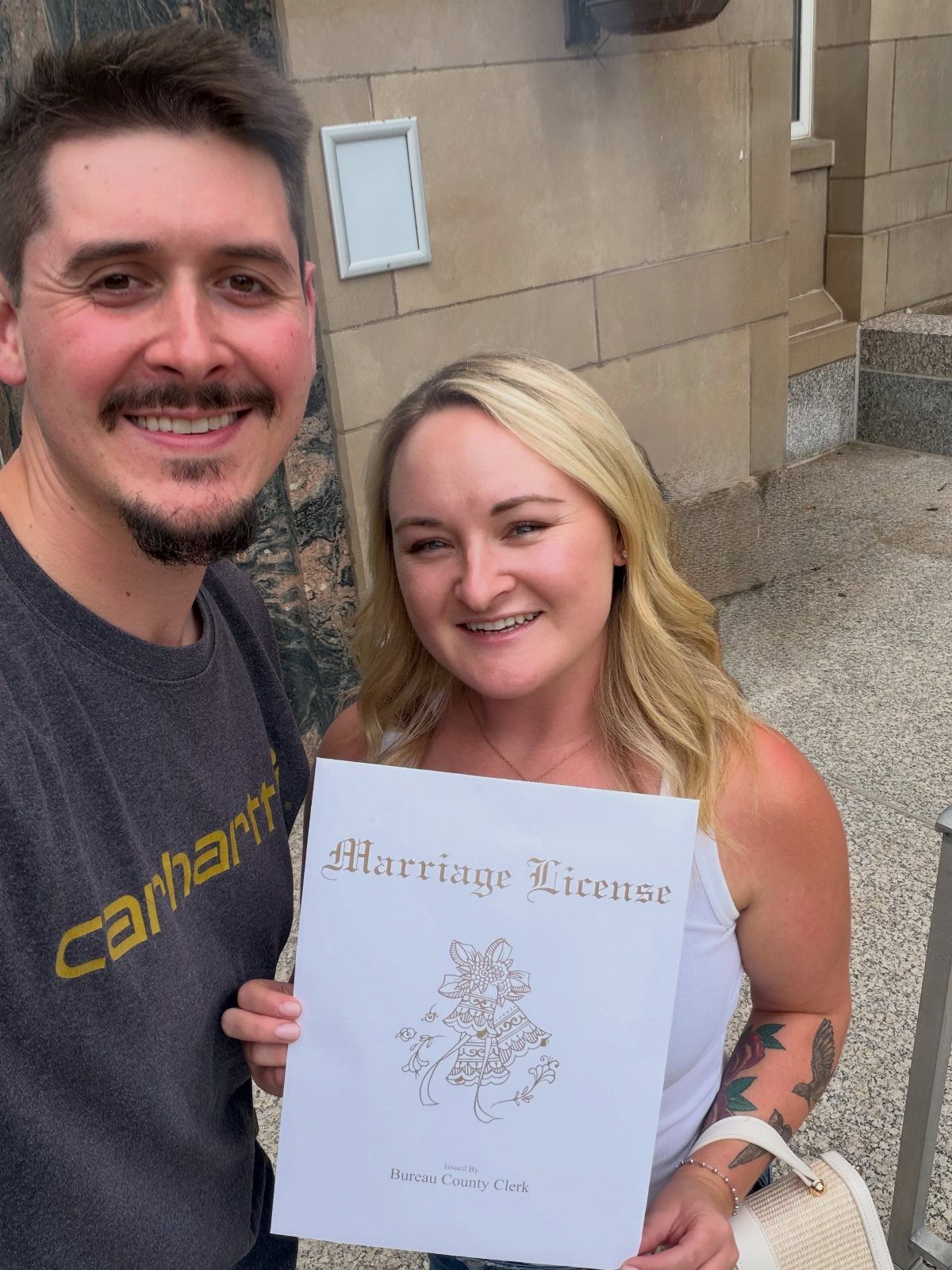
Bureau County Clerk is the name on that document, and it shows who actually issues yours: a county clerk’s office, not the venue or the officiant.
Call the one in the county where you’ll marry and ask what ID it wants, what it costs, and whether both of you must appear in person.
Ask how long the license stays valid and whether a waiting period applies. Rules vary by state, so confirm before you pick a date.
Put the signed license in the hands of whoever is officiating, and name a backup person to check it’s there.
2. Rehearsal Dinner

The night prior is when everyone with a job on the day sits down together and learns it.
Run the ceremony walk-through first, then eat. A slideshow of photos of the two of you, like the one on that screen, gives guests who have never met something to talk about.
If money is tight, invite only the wedding party and immediate family. A smaller room runs well under the price of a big one.
3. Wedding Favors

Small, edible, and labeled: a gold-wrapped chocolate in a white box with a bow and a tag stamped with your initials and date. I like this version because nobody has to decide whether to keep it.
Chocolate also scales with your budget, since you buy it by the piece. Count your confirmed guests, then add a few extras for stragglers.
Tie the tags on a week or two ahead, not the night before. Printing initials and a date takes a proofread, so check the numbers twice.
4. Seating Chart
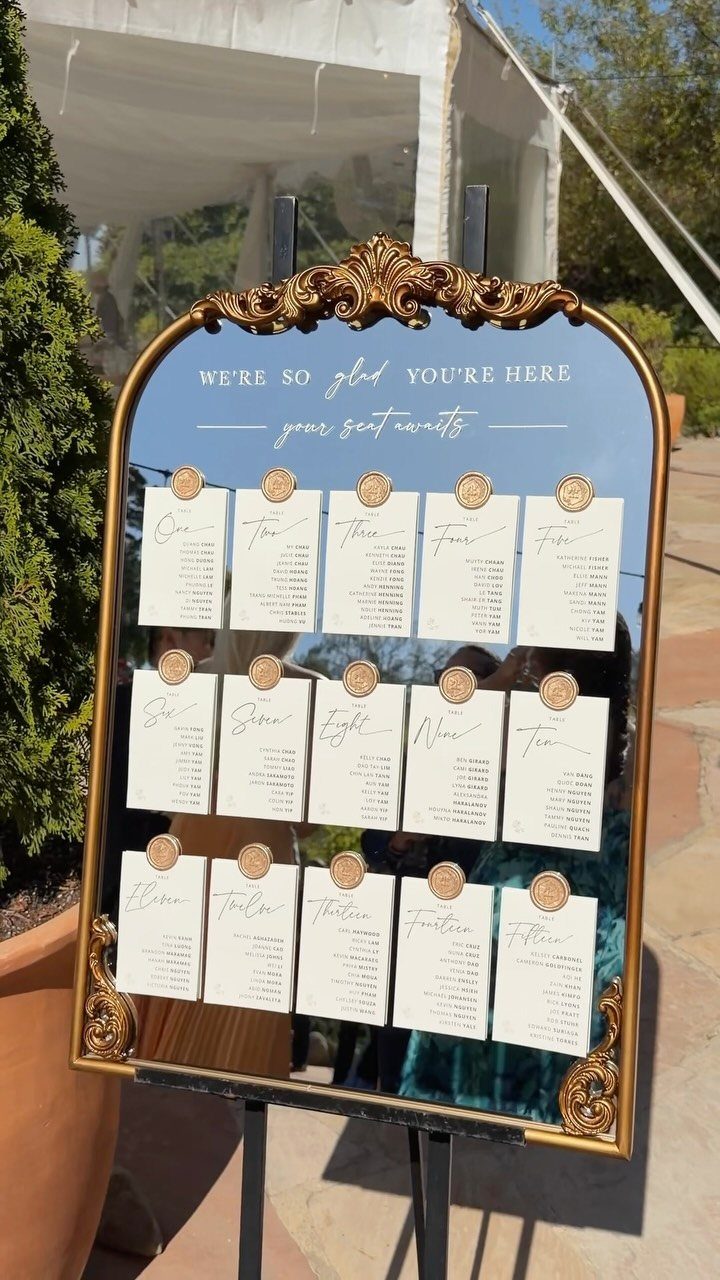
A big table count means guests hunt for their names in a hurry, and one large display fixes that.
Put the whole seating plan in one spot at the entrance, on a single large display such as a mirror with a card for each table.
Finalize the layout only after your RSVP deadline passes, because reprinting cards costs time and money.
A frame like this can stand outdoors beside a tent, but anchor it so wind can’t knock it over.
Importance of a Wedding Planner
A planner is optional, and plenty of couples plan their own weddings. Hire one if the part you dread is the tiny details: confirming arrivals, chasing vendors, fixing what breaks on the day.
Years of working with the same florists, caterers and DJs often give a planner a rate card you can’t get on your own, and some of those savings reach your bill.
Ask any planner you interview whether they pass those rates along, and weigh that against their fee before you decide.
If the full fee strains your budget, price out a smaller package and see what it covers. Then compare it to the hours you’d spend doing the same work yourself on a deadline.
Tipping Wedding Vendors
Vendors count on gratuities as a sign you were happy with the work, and a planner belongs on that list too. A planner tip of about 10–20% of their fee is a reasonable range to consider.
Add that amount to your budget early, so it doesn’t land as a surprise after the final payments. If money is tight, a smaller tip with a warm, specific thank-you note still lands well.
Wedding Insurance
Book the policy the same week you sign the venue contract, since that deposit is the first money you could lose. That is when you have the most money at risk and the least control over what might go wrong.
Check your venue contract first, since some venues require proof of coverage. If yours does, ask what the policy must include and what deadline applies.
Get a quote before you pay any large deposits. A policy that costs a small fraction of your budget can protect the rest of it.
Frequently Asked Questions
How much does a wedding planner cost?
Budget somewhere in the low thousands at minimum, and more for full-service planning in a big city. The final number depends on the size of your guest list, how many vendors you have and how complex the event is.
A tight budget doesn’t rule a planner out; ask for a scaled-down package, then weigh what it covers against the hours you’d otherwise put in yourself.
How long do you need to plan a wedding?
Start at least a year before the date.
Starting a year out leaves room to plan at a calm pace, and the popular venues and vendors still have open dates. Popular venues and peak-season dates can call for even longer lead time.
Do you tip a wedding planner?
Yes, a planner belongs on your tipping list. Most couples land between 10% and 20% of the planner’s fee.
Put the tip line in your budget from the start so the final payments don’t catch you off guard; if cash runs short, a smaller amount paired with a handwritten note that names what they did well still means a lot.
How do you coordinate a wedding?
Keep one detailed list of every vendor with contact information, service agreements and payment schedules, and stay in regular contact with each one. Wait until RSVPs close before you lock the seating chart.





